'cookieChoices = {};' aneka wawasan

Hayo Berpikir Secara Luas

Pages

Powered by Blogger.

Popular Posts

Blogger news

Visitors

Blogger templates

Visitor

Thursday, July 3, 2014

Mempelai Pria Yang Kehilangan Mempelai Wanitanya


Mempelai Pria Yang Kehilangan
Mempelai Wanitanya

Jaman dahulu kala, ada suatu keluarga kaya di Benares-India Utara, yang tengah merencakan pernikahan putera mereka dengan seorang gadis jujur yang baik dari desa terdekat. Mempelai perempuan ini sangat cantik, sehingga mereka yakin bahwa mereka tidak akan dapat menemukan istri yang lebih baik lagi untuk anak mereka itu.
Lalu keluarga mempelai pria memilih tanggal pernikahan, dan keluarga mempelai wanita setuju menunggu mereka di desa pada hari pernikahan. Ketika itu, saat pendeta ahli astrologi dari keluarga kaya ini mengetahui bahwa mereka telah memilih hari pernikahan tanpa membayar upah konsultasi tentang bintang-bintang, ia menjadi marah. EEEm….., rupanya keluarga ini tidak membayar upah konsultasi denganku. Tunggu pembalasanku, mereka perlu di beri pelajaran!” seru kata hati si pendeta dan memutuskan untuk mempermainkan mereka.
Ketika hari pernikahan tiba. “HHMMM…., kini saatnya aku beraksi!” pikir si pendeta ahli astrologi itu sambil mengenakan jubah terbaiknya, dan memanggil seluruh anggota keluarga itu. Si pendeta membungkuk seraya memberi hormat kepada mereka semua, dan kemudian melihat ke peta bintang-bintangnya dengan sangat serius. Lalu ia memberitahu mereka bahwa sebuah bintang terlalu dekat ke horizon, planet lain berada di tengah-tengah perbintangan yang tidak beruntung, dan bulan berada dalam keadaan yang sangat berbahaya untuk mengadakan pernikahan. Si pendeta berseru kepada mereka,” Kalian telah berlaku gegabah, tidak meminta nasehatku. Tahukah kalian bahwa kalian telah memilih hari terburuk di tahun ini untuk melangsungkan sebuah pernikahan!” “adakah yang salah?, pendeta,” tanya mereka serempak. “Ya, bintang-bintang tidak baik letaknya, jika hal ini tetap kalian langsungkan, tampaknya akan berdampak pada pernikahan yang mengerikan!.”
“Haa….!! Seru mereka kaget. “ Lalu apa yang harus kami lakukan?,” Tanya mereka mendesak. “Kalian harus membayar kaul pembuang sial!,” tegas si pendeta ahli astrologi itu. Ketakutan terhadap apa yang pendeta itu katakana, keluarga kaya tersebut menuruti kehendak si pendeta dan mengurungkan niat mereka dan tetap tinggal di rumah mereka di Benares. Mereka melupakan semua hal tentang kualitas-kualitas menakjubkan dari mempelai wanita. “Ehm, ha… ha…. Ha…, rasakan pembalasanku hari ini!” tawa si pendeta Astrologi itu sembunyi-sembunyi.
Saat bersamaan, keluarga mempelai wanita telah menyiapkan semua hal untuk merayakan pernikahan di desa mereka. Ketika tiba saat yang telah disepakati. “Kemana mreka ya?,” Tanya si ibu mempelai wanita. “Ah, mungkin mereka hanya terlambat sebentar,’ jawab kerabat mereka. “Biarlah kita menunggu beberapa waktu lagi, mungkin mereka terhambat di perjalanan,” si ibu mencoba menyabarkan suasana.
Namun, setelah beberapa saat kemudian, mereka tampaknya tidak melihat sama sekali kedatangan rombongan mempelai pria dan keluarganya. Mereka menyadari bahwa mempelai pria tidak akan datang. Rasa gusar mengoyak suasana yang seharusnya gembira, “ Ini penghinaan! Orang-orang kota yang telah memilih tanggal dan waktu, tetapi sekarang mereka tidak datang!” “Ini sudah terlalu menyakitkan. Mengapa kita harus menunggu lebih lama lagi?,” kata seseorang. :Kita harus mempersilahkan anak perempuan kita menikah dengan seorang pria yang terhormat dan rajin dari desa kita ini,”
Pikir mereka. Akhirnya mereka berkeputusan dan dengan cepat mengatur sebuah pernikahan baru dan merayakannya dengan penuh kegembiraan.
Hari berikutnya, pendeta ahli astrologi tiba-tiba berkata kepada keluarga kaya itu bahwa hari ini adalah hari yang paling sempurna untuk mengadakan pernikahan karena bintang-bintang, planet-planet dan bulan dalam posisi yang sempurna! Keluarga kaya itu tergesa-gesa pergi ke desa mempelai wanita dan meminta agar pernikahan segera dilangsungkan. “Kalian telah memilih tanggal dan waktu. Kemudian kalian mempermalukan kami dengan ketidak datangan kalian!” kata para pendedeku desa mempelai wanita.
“Pendeta keluarga kami mengatakan bahwa kemarin adalah hari yang sangat tidak beruntung untuk melangsungkan suatu pernikahan karena bintang-bintang, planet-planet dan bulan berada dalam posisi yang tidak tepat. Dan dia telah menyakinkan kami bahwa hari ini adalah hari yang paling beruntung. Jadi tolong bawa keluar mempelai wanita segera!” pinta keluarga dari Benares itu.
“Kalian tidak dihormati lagi. Kalian telah memutuskan bahwa pemilihan tanggal adalah lebih penting dari pada pemilihan mempelai. Terlalu terlambat sekarang! Puteri kami telah menikah dengan pria lain,” jawab keluarga desa itu. Kedua keluarga itu mulai bertengkar dengan riuh.
Ketika itu, seorang bijaksana sedang melintas. Melihat percekcokan kedua keluarga itu, ia mencoba mendamaikan perselisihan tersebut.
Keluarga dari Benares memberitahunya bahwa mereka mendengarkan peringatan dari pendeta ahli astrologi mereka. Itu adalah di karenakan  posisi bintang-bintang, planet-planet dan bulan yang tidak tepat, maka mereka memutuskan untuk mengganti hari pernikahan.
“Keberuntungan yang baik ada pada mempelai wanita ini, bukan di bintang-bintang. Kalian orang bodoh yang telah mengikuti bintang-bintang dan telah kehilangan mempelai, tanpa kebodohan kalian, bintang-bintang yang begitu jauh tidak dapat melakukan apapun!” jawab orang bijak itu.

Pesan moral dalam cerita ini adalah
Keberuntungan dan berkah datang
Dari perbuatan-perbuatan yang baik,
Bukan dari bintang-bintang.

Nasehat bagi orang yang hendak menikah:
Apabila kamu memperoleh seorang teman yang bijaksana,
Rekan seperjalanan yang berprilaku baik dan bijak, setelah
Mengatasi semua bahaya bolehlah engkau
Hidup bersamanya dengan gembira dan penuh kesadaran.
(Dhammapada 328)
irawan Religi
Wednesday, July 2, 2014

Story The One-hundredth Prince


 The One-hundredth Prince

[Obedience to a Wise Teacher]
A long time ago, there was a king who had one hundred sons. His youngest son, Prince
Gamani, was a very energetic, patient and kind chap.

All the princes had their own teachers. And even though Prince Gamani was one-hundredth
in line to the throne, he was fortunate enough to have the best teacher. Someone with the
most learning and the wisest of them all. Nobody knew, but this honourable gentle teacher
was actually the rebirth of a Bodhisattva. He was like a father to Prince Gamani, who adored,
respected and obeyed him.
In those days, it was the custom of the country to send each educated prince to a different
province, to develop it and to help the people
.
When Prince Gamani was old enough for this
assignment, he went to his teacher and asked which province he should request. “Do not
select any province. Instead, tell your father that if he sends you, his one-hundredth son,
out to a province, there will be no son remaining to serve him in his home city,” advised
his teacher. Prince Gamani did as he was told, and pleased his father with his kindness
and loyalty.
Some time later, the prince again went to see his teacher. “How best can I serve my father
and the people here in the capital city?” he asked. The wise teacher replied: “Ask the king to
appoint you as the person-in-charge of fees and tax collection, and of benefits distribution
to the people. If he agrees, always remember to carry out your duties honestly and fairly,
with energy and kindness.”
As with the first time, the prince obeyed his teacher’s advice. Trusting his one-hundredth
son, the king was glad to assign these duties to him. When the young prince carried out his
duties - the difficult task of collecting fees and taxes, he was always gentle, fair and lawful.
When he distributed food to the hungry, and other necessities to the needy, he was always
generous, kind and sympathetic. Before long, the one-hundredth prince gained the respect
and affection of all.
Eventually, the time came for the king to go. His ministers asked him, on his deathbed,
who should be the next king. “All one hundred of my sons have a right to succeed me. The
decision on who should be the next king lies with the citizens,” he replied.

After he died, all the citizens agreed to make the one-hundredth prince their next ruler.
They crowned him King Gamani the Righteous because of his wholesome character.
When the ninety-nine older brothers heard what had happened, they felt insulted. Filled
with envy and rage, they prepared for war. They sent a message to King Gamani that reads:
“We are all your elders. Neighbouring countries will laugh at us if our country is ruled by
the one-hundredth prince. Either you give up the kingdom or we will take it by force!”
After he received this message, King Gamani took it with him to his wise old teacher, and
sought his advice.
“Tell your brothers you refuse to wage war against them. Tell them you will not help them kill
innocent people you have come to know and love. Tell them that, instead, you are dividing
the king’s wealth among all one hundred princes. Then send each one his portion,” advised
the wise teacher. Again, the king obeyed his teacher.
Meanwhile, the ninety-nine older princes had brought their ninety-nine small armies to
surround the royal capital. When they received the king’s message and their small portions
of the royal treasure, they held a meeting. They decided that each portion was so small it
was almost meaningless. Therefore, they would not accept them.
But then they realised that, in the same way, if they fought with King Gamani and then
with one other, the kingdom itself would be divided into many small worthless portions.
When that happened, each small part of the once great kingdom would be weak in the face
of any hostile country. So they sent back their portions of the royal treasure as offerings of
peace, and accepted the rule of King Gamani.
The king was pleased, and invited his brothers to the palace to celebrate the peace and
unity of the kingdom. He entertained them in the most perfect ways - with generosity,

pleasant conversation, providing kind instructions for their benefit, and treating all with
even-handed courtesy.
The king and the ninety-nine princes became close friends. Their ties were much stronger and
closer than they had been as brothers. It was also a well-known fact in all the surrounding
countries that they strongly supported one another. Thus, no one dared threaten the kingdom
or its people. After a few months, the ninety-nine brothers returned to their provinces.
In gratitude, King Gamani the Righteous invited his wise old teacher to live in the palace.
He honoured him with great wealth and many gifts, and even held a celebration for his
respected teacher, announcing to the full court: “I, the last-born among one hundred worthy
princes, owe all my success to the wise advice of my generous and understanding teacher.
Even the unity and strength of this kingdom are due to my beloved teacher. Likewise, all
who follow their wise teachers’ advice will earn prosperity and happiness.”
The kingdom prospered under the remaining rule of the generous and just King Gamani
the Righteous.
The moral is

one is rewarded a hundred times more for following the advice of a wise
teacher.
irawan Religi

Kampak Yang mematikan


Kampak Yang Mematikan

Di masa lampau, ada seorang tukang kayu berkepala botak/plontos yang mengkilap. Pada hari yang sangat terik, kepala botaknya memantulkan cahaya menyilaukan sehingga orang-orang harus menutup mata mereka saat berpapasan atau berbicara dengannya!.
Suatu hari yang sangat cerah, seekor nyamuk kelaparan tertarik dengan kepala botak tukang kayu yang menyilaukan ini. Ia berputar-putar mengelilingi kepala si tukang kayu “Nging………... Nginggg……….. ngiiiing……..… .” Ia hinggap di kepala tukang kayu itu dan mulai mengigit.
Tukang kayu yang sedang sibuk menghaluskan sepotong kayu dengan ketam, merasakan gigitan nyamuk tersebut.”hush… hush…. ,” Ia berusaha mengusir nyamuk itu dengan mengibaskan tangan di kepalanya beberapa kali, namun nyamuk kelaparan itu tidak mau pergi, “Ngiiiing…. Nging…… Ngiiiiiing…. “ nyamuk itu masih terbang berputar-putar di kepala tukang kayu. Sehingga, lelaki tua itu berteriak memanggil anaknya dan memintanya untuk mengenyahkan nyamuk yang nakal itu. “Andre, tolong kemari sebentar. Bantu ayah mengusir nyamuk yang menggangu kepala ayah.” “Sebentar ayah, saya akan segera kesana !,” jawab si anak gembira yang mengira ia mendapat tugas istimewa.
Anak si tukang kayu bukanlah seorang anak cerdas, walau ia seorang anak yang suka bekerja keras dan patuh, “Jangan khawatir ayah, Aku akan membunuh serangga itu dengan hanya satu pukulan saja !” katanya berseru.
Tak lama kemudian, anak tersebut mengambil kampak yang sangat tajam. Perlahan-lahan ia mengendap-endap mendekati ayahnya yang tidak mengetahui kedatangan anaknya, lalu ia membidik nyamuk itu dengan hati-hati. Tanpa berpikir dua kali, ia mengayunkan kampaknya dan membelah nyamuk itu menjadi dua!. Namun apa yang terjadi?. Celaka, nyamuk itu memang mati, namun kampak yang tajam itu juga membelah kepala botak si tukang kayu.
Saat itu, seorang penasehat raja sedang melintas dengan pengawal-pengawalnya. Mereka melihat apa yang tengah terjadi dan mereka tercengang melihat ada seorang anak yang sangat bodoh berlaku seperti itu!
“jangan terkejut dengan kebodohan manusia!. Ini mengingatkan aku atas kejadian yang mirip dan baru saja terjadi kemarin.” Kata si penasehat raja.

Alu pembunuh lalat

Di perkampungan yang tidak jauh dari kota, ada seorang wanita yang asyik membersihkan padi, menumbuk padi di palungan dengan alu yang memecahkan kulit padi agar menjadi beras. Wanita tersebut bekerja sangat giat sehingga peluh bercucuran di sekujur wajah dan tubuhnya, dan tampak sekawanan lalat terbang berdenging di seputar kepalanya. Ia telah berusaha mengusirnya, namun lalat-lalat itu tidak juga pergi.
Akhirnya, “Astriii… !!!,” teriak wanita itu memanggil anak perempuannya. “Yaa… bu, ada apa?, tungggu sebentar ya!”, jawab anaknya. “Kemari cepat nak, tolong usir lalat-lalat ini,” pinta wanita itu. Meski anak perempuannya tampak bodoh, tetapi ia selalu ingin melakukan yang terbaik untuk menyenangkan hati ibunya, lalu ia bertanya lagi, “Dimana lalat-lalat yang mengganggu ibu itu?” “ini, di sekeliling kepala ibu,” jawab ibunya itu.
Tak lama kemudian, tanpa basa-basi, perlahan-lahan anak perempuan itu berjingkit-jingkit menghampiri ibunya dan berdiri di palungan, mengangkat alu dan membidik lalat yang paling besar dan gemuk. Tanpa berpikir panjang, dengan sekuat tenaga si anak itu memukul lalat yang sedang hinggap di kepala ibunya hingga mati! Tak ayal lagi, tentu saja pukulan pembunuh lalat itu juga mengakhiri nyawa ibunya. “Ach… ibu, mengapa ibu malah tertidur…. Bukankah ibu menyuruhku memukul lalat-lalat itu. Ayo ibu, bangunlah,” teriak putrinya yang tidak mengerti bahwa pukulannya telah menyebabkan ibunya turut meninggal.
“Ah, betapa malangnya nasib si ibu. Kalian tahu apa yang di katakan orang-orang?” Tanya si penasehat mengakhiri ceritanya, “Dengan orang-orang seperti ini, siapa lagi yang perlu musuh!”

Pesan moral dalam cerita ini adalah
Seorang musuh yang bijak,
Lebih tidak berbahaya
Daripada orang yang bodoh.

Orang-orang dungu yang kurang cerdas
Menggembara bersama dirinya sebagai musuh.
Perbuatan buruk yang dilakukannya
Menghasilkan buah yang pahit.
(Dhammapada 66)
irawan Religi

Monyet Jadi tukang kebun


Monyet jadi tukang kebun

Cerita ini terjadi sebelum Hari Tahun Baru di Benares – India Utara pada masa yang sangat lampau. Setiap orang di kota itu, termasuk tukang kebun di taman peristirahatan raja, sedang sibuk mempersiapakan perayaan yang akan diadakan tiga hari lagi.
Saat itu, di taman peristirahatan tersebut hiduplah segerombolan besar monyet. Mereka selalu mendengarkan nasehat pemimpin mereka, raja monyet, sehingga mereka tidak perlu berpikir terlalu banyak.
Karena tukang kebun kerajaan itu ingin merayakan liburan Tahun Baru sebagaimana orang lain, ia memutuskan untuk menyerahkan tugasnya kepada para monyet. “oh raja para monyet, temanku yang mulia, sudikah engkau membantuku?” tanyanya kepada raja monyet. “Apa yang dapat kami lakukan?” Tanya si raja Monyet. “Tidak sulit, sahabatku.” Jawab si tukang kebun. “Hari Tahun Baru akan tiba, dan aku ingin merayakannya bersama keluargaku. Aku akan pergi jauh selama tiga hari penuh. Ada banyak buah, diantaranya ada buah berri dan kacang yang dapat dimakan di kebun indah ini. Silakan menjadi tamuku, dan makanlah sebanyak yang kamu dan para pengikutmu inginkan. Tetapi sebagai balas jasa, tolong sirami pepohonan dan tumbuh-tumbuhan muda selama aku pergi,” kata si tukang kebun.
“Jangan khawatir temanku! Kami siap menggantikan tugasmu dan melakukan pekerjaanmu dengan baik! Nikmatilah liburanmu bersama keluarga!” janji si raja monyet.
Si tukang kebun itu menunjukkan kepada para monyet di mana ember untuk menyiram di simpan. Merasa yakion tanpa ragu lagi ia pergi merayakan hari libur besar itu. “Selamat Tahun Baru” seru para monyet ketika ia akan pergi, dan si tukang kebun hanya melambaikan tangannya sambil berguman, “Ehm…, Akhirnya aku bisa lega menikmati liburan bersama istri dan anak-anakku.” “Tralala, tralala… trilili…trilili…. ,” begitu nyanyian keluarga si tukang kebun.
Esok hari, ketika matahari mulai menyingsing. Di kebun raja, tampak kesibukan yang luar biasa. Para monyet mengisi ember-ember, dan mulai menyirami pepohonan dan tumbuhan muda. Tiba-tiba si raja monyet berseru, “Wahai rakyatku, sangat tidak baik kita memboroskan air. Air itu sangat dibutuhkan manusia untuk banyak keperluannya, demikian juga bumi kita,” “Karena itu, cabutlah tiap pohon muda atau tanaman sebelum menyiramnya, Periksa seberapa panjang akarnya. Berikan air berlebih untuk yang memiliki akar panjang, dan agak sedikit untuk akar yang lebih pendek. Dengan cara demikian, kita tidak akan menghambur-hamburkan air dan tukang kebun itu akan senang!” Demikian perintah si raja monyet.
Tanpa berpikir dua kali, para monyet yang patuh itu mengikuti perintah rajanya.
Kebetulan saat itu, seorang bijak sedang melintasi pintu masuk kebun itu. Ia tercengang melihat para monyet sedang mencabuti pepohonan dan tanaman muda, mengukur akarnya, dan dengan hati-hati menuangkan air pada lubang di tanah. “Oh monyet-monyet bodoh, apa yang sedang kalian pikirkan dan kalian kerjakan terhadap kebun raja yang sebelumnya indah ini? Mengapa kebun raja jadi berantakan seperti ini?,” tanyanya.
“Kami sedang menyirami pohon-pohon dan tanaman tanpa usah memboroskan air! Kami di perintahkan raja kami untuk melakukannya dengan cara seperti ini,” Jawab mereka.
“Oh, jika ini adalah kebijaksanaan dari yang terbijak di antara kalian – pemimpinmu – apa jadinya kalian ini? Bermaksud melakukan perbuatan baik, malah sebaliknya kalian melakukan penghancuran, sungguh bodoh!” kata orang bijak itu. “Entah bagaimana nasib si tukang kebun nanti apabila raja mengetahui bahwa taman bunganya telah hancur berantakan.

Pesan moral pada cerita ini adalah
Karena kebodohan semata
dapat mengubah perbuatan baik
menjadi buruk.

irawan Religi
Monday, June 30, 2014

Story Little Prince No-father


Little Prince No-father

[The Power of Truth]
A long time ago, the King of Benares went on a picnic in the forest. The beautiful flowers,
trees and fruits made him very happy. Mesmerised by the beauty of nature, he went deep
into the forest. Before long, he realised he was lost and separated from his companions.

Then he heard the sweet voice of a young woman singing. To avoid being stranded in the
forest, the king followed the sound of the lovely voice. When he finally came upon the singer,
he discovered that she was a beautiful fair young maiden who was collecting firewood. He
fell in love with her immediately. They became very friendly and intimate, and the king
even fathered her child.
Later, he explained how he had gotten lost in the forest, and convinced her that he was
indeed the King of Benares. She gave him directions back to his palace, and the king gave
her his valuable signet ring. “If you give birth to a baby girl, sell this ring and use the money
to bring her up well. If our child turns out to be a baby boy, bring him to me along with
this
ring for recognition,” instructed the king. Saying that, he departed for Benares.
Months later, the fair maiden gave birth to a cute little baby boy. As she was a simple shy
woman, she was afraid to take her little one to the fancy court in Benares, but she kept the
king’s signet ring.
Time passed and the baby grew up. When he played with the other children in the village,
they teased and mistreated him. They even picked fights with him, all because his mother
was not married. “No-father! No-father! Your name should be No-father!” they yelled at him.
Of course, all this made the little boy ashamed. He felt very hurt and sad. He would often
run home crying to his mother. One day, he told her the nickname the other children gave
him. “Don’t be ashamed, my son. You are not just an ordinary little boy. Your father is the
King of Benares!” said his mother gently.
The little boy was very surprised. “Do you have any proof of this?” he asked his mother. So
she told him all about his father, his gift of a signet ring to her and his instructions that if

she had a baby boy she should bring him to Benares, along with the ring as proof. “Let’s
go then, mother, let’s go look for my father,” said the little boy. She agreed, and the next
day they set off for Benares.
When they arrived at the king’s palace, the gatekeeper told the king that a woman and her
little son wanted to see him. The mother and son were taken into the royal assembly hall,
which was packed with the king’s ministers and advisers. The woman reminded the king of
their time together in the forest. Finally she said: “Your Majesty, here is your son.”
Ashamed in front of all the ladies and gentlemen of his court, the king denied even though
deep in his heart he knew the woman spoke the truth. “He is not my son!” he said. Then
the lovely young mother showed the signet ring as proof.
Again, the king fearing humiliation denied the truth. “This is not my ring!”
The poor woman thought: “I have no witness and no evidence to prove what I say. I have
only my faith in the power of truth.” So she replied to the king: “If I throw this little boy
up into the air, and if he truly is your son, may he remain in the air without falling. If he
is not your son, may he fall to the ground and die!”
Suddenly, she grabbed the boy by his foot and threw him up into the air. Lo and behold,
the boy sat in the cross-legged position, suspended in mid-air, without falling. Everyone
was astonished! Suspended in the air, the little boy spoke to the mighty king. “My lord, I
am indeed your own flesh and blood. You take care of many people who are not related to
you. You even keep and feed countless elephants, horses and other animals. And yet, you
are not concerned about looking after and raising me, your own son. Please do take care
of me and my mother.”
The king was humbled by the truth of the little boy’s powerful words. Overcoming his pride,

the king held out his arms and said: “Come to me my son, and I will take good care of you.”
Amazed by such a miracle, all the others in the court put out their arms. They too asked
the levitating little boy to come to them. But he floated directly in mid-air into his father’s
arms. With his son seated on his lap, the king announced that he would be the crown prince,
and his mother the queen.
In this way, the king and his people learned the power of truth, and Benares became
famous as a place of justice. When the king passed away, the grown-up crown prince wanted
to show the people that all deserve respect, regardless of birth. He had himself crowned
under the official name, “King No-father!” and went on to rule the kingdom in a generous
and righteous way.
The moral is

The truth is always stronger than a lie.
irawan Religi

Story Prince Goodspeaker and The Water Demon


 Prince Goodspeaker and
The Water Demon


[Chapter 1. Rebirth of the Bodhisattva]
Once upon a time, there was a very righteous king. He had a lovely queen who gave birth
to a beautiful baby. The king was very happy. Wanting to give his son a name that might
help him later in life, he called him Prince Goodspeaker.

This prince was no ordinary baby. This was not his first life nor his first birth. Millions
of years before, he had been a follower of a Buddha - a fully “Enlightened One”. He had
wished with all his heart to become a Buddha just like his beloved master - to gain the same
enlightenment and experience of complete truth.
Lives after lives, he had been reborn - sometimes as poor animals, sometimes as long-
living gods and sometimes as human beings. He always tried to learn from his mistakes
and develop the “Ten Perfections”, so he could purify his mind and remove the three root
causes of unwholesomeness - the poisons of craving, anger and the delusion of a separate
self. By using the Perfections, he would someday be able to replace the poisons with the
three purities - non-attachment, loving-kindness and wisdom.
No one really knows about the millions of lives lived by this great Bodhisattva. But many
stories have been told - including this one about a prince called Goodspeaker. After many
more rebirths, he became the Buddha who is remembered and loved in all the world today.

[Chapter 2. The Teachings of the Gods]
Soon after, the queen gave birth to another son. He was named Prince Moon. When both
children had just learnt to walk, their mother suddenly became very ill and passed away.
To help him look after his playful children, the king found a princess to become his new
queen. A few years later, this queen gave birth to a beautiful bright little boy. He was named
Prince Sun. Pleased with his queen and wanting to reward her for bringing up all three
children, he promised to grant her one wish.
“Thank you my lord, I will tell you my wish
in the future,” replied the queen after careful consideration.
Days flew by, and the three princes soon grew up. The queen noticed that Prince Goodspeaker
was intelligent and understanding. “If these two older princes remain in the palace, my son,
Prince Sun, will never get a chance to be king. Therefore, I must do something to make him
the next king,” thought the new queen.
One day, when the king was in a good mood, the queen respectfully approached him and
reminded him of the one wish he had granted her. As he was in a happy mood, the king
said: “Ask whatever you want!” “Oh my husband and king, grant my wish that our son,
Prince Sun, will succeed you as the next king when you pass away,” she answered.
The king was shocked by
her request. He became angry and said: “My first two children are
like bright stars! How can I hand the throne over to my third son? My citizens will blame
me. That cannot be done!” The queen kept quiet.
Even though the king was in a good mood earlier, he was now worried and anxious. He
was afraid that his queen might scheme to kill his first two sons. He decided that he must
do something to ensure the safety of his two older children.

The king secretly called the two princes to him. He told them of the queen’s dangerous
desire, and sadly bade them farewell so that they could remain safe from the queen’s plot
-
ting. They should return only after their father’s death to take their rightful places and rule
the kingdom. The two obedient princes accepted their father’s order and prepared to leave.
In a few days, they were ready. They said painful goodbyes to their father and friends, and
left the palace. On their way through the royal gardens, they chanced upon Prince Sun.
The youngest prince had always been very affectionate and friendly towards his two older
half-brothers, and was upset to hear that they were leaving the palace. So he decided that
he too would leave the kingdom. The three friendly princes departed together.
For several months they travelled, until they reached the forest of the mighty Himalayas.
Weary and tired from the journey, they sat down under a tree to rest. Then the eldest
brother, Prince Goodspeaker, instructed the youngest prince to fetch some water from a
nearby lake using lotus leaves. “Bring them back here so we can all have a drink,” he said.
But the princes did not know that the beautiful dark blue lake was possessed by a water
demon! He was permitted by his demon king to eat any beings that he could convince to
venture into the water. But there was one condition. He could not eat anyone who knew
the answer to this question - “What are the teachings of the gods?”
When Prince Sun arrived at the lake, he was dehydrated, dirty and tired. He went straight
into the water without a second thought. The water demon rose up from under the water
suddenly and captured him. “What are the teachings of the gods?” demanded the demon.
“I know the answer to that! The sun and the moon are the teachings of the gods,” replied
the prince. “You don’t know the teaching of the gods, so you belong to me!” laughed the
water demon and pulled Prince Sun under the water and locked him up in a deep cave.
When Prince Sun did not return after some time, Prince Goodspeaker asked his second
brother, Prince Moon, to fetch the water from the lake. When he reached there, he too went

right into the water immediately. Again, the water demon appeared, grabbed him and asked:
“What are the teachings of the gods?” Prince Moon’s replied: “The four directions - North,
South, East and West - these are the teachings of the gods.” “You don’t know the teach
-
ings of the gods, so you belong to me!” guffawed
the water demon. Then he imprisoned
Prince Moon in the same underwater cave with Prince Sun.
When both his brothers did not return, Prince Goodspeaker began to worry that they might
be in some danger. He went to the beautiful dark blue lake searching for them. As he was a
wise and careful person, he did not step into the water immediately. Instead, he investigated
and saw that there were two sets of footprints which led into the lake - but not out of it! To
protect himself, he got his sword, bow and arrows ready, and began to walk around the lake.
Seeing that this prince did not go straight into the lake, the water demon appeared disguised
as a humble villager and said: “My dear friend, you look tired and dirty. Why don’t you get
into the water, take a bath, drink, and eat some lotus roots?”
Remembering the one-way footprints, Prince Goodspeaker demanded: “You must be some
kind of demon disguised as a human! What have you done with my brothers?” Surprised
at being recognised so quickly, the water demon returned to his true ferocious form. “By
my rights, I have captured your brothers!”
“For what reason?” asked the prince. “So that I can gobble them up!” answered the demon.
“I have permission from the demon king to feed on all who step into this lake and do not
know the teachings of the gods. Only one who knows the teachings of the gods is spared.”
“Why do you need to know the teachings of the gods? What good does it do for a demon like
you?” asked the prince. The water demon replied: “I know there must be some advantage
to me.” “Then I will tell you what the gods teach,” said Prince Goodspeaker.
“But I have a
problem. Look at me. I am all covered with dust and dirt from travelling. I cannot speak
about wise teachings in this condition.”

By now, the water demon realised that this prince was especially wise. He had him washed
up and refreshed. He also gave him water to drink, tender lotus roots to eat and prepared
a comfortable seat decorated with pretty wildflowers for him. After laying aside his sword,
bow and arrows, the Bodhisattva sat on the adorned seat. The ferocious demon sat by his
feet, just like a student listening to a respected teacher as he said:
“These are the teachings of the gods:
You should be ashamed to do unwholesome deeds.
You should be afraid to do unwholesome deeds.
You should always do wholesome deeds - deeds that bring happiness to others and help
mankind.
Only then will you find inner peace and happiness.”
The water demon was pleased with his answer. “Worthy prince, you have completely
satisfied my question. You have made me so happy that I will return you one of your
brothers. Which one do you choose?”
“In that case, release my youngest brother, Prince Sun,” declared Prince Goodspeaker. “My
lord prince and wise one, you know the teachings of the gods but you do not practise them!”
replied the demon to Prince Goodspeaker’s choice. “Why do you say that?” asked the prince.
“Because you leave the other brother to die, saving only the youngest. You do not respect
seniority!” answered the demon.
To this, the prince replied: “Oh demon, I know the teachings of the gods, and I do practise
them. The three of us came to this forest because of our youngest brother. His mother
wants him to be the next king. So it is for our protection that our father, the present king,
sent us here. The young Prince Sun joins us out of friendship. But if we return to the court
without him, and say he was eaten by a water demon who wants to know the teachings of

the gods, who would believe us? They would think we killed him because he is the cause of
our danger. This would bring shame to us and unhappiness to the kingdom. Fearing such
terrible consequences, I command you again to release the young Prince Sun.”
The water demon was so pleased with this answer that he said: “Well done, well done, my
lord. You know the true teachings of the gods, and you do practise them! I will gladly
return
both brothers to you!” Saying that, he descended into the lake and brought both princes
up. They were wet but unharmed.
The Bodhisattva further gave helpful advice to the demon. He said: “Oh water demon, my
new friend, you must have committed many unwholesome deeds in your previous lives
to be born as a flesh-eating demon. If you continue your old ways, you will be trapped in
a terrible state even in later lives. For unwholesome deeds only lead to shame, fear and
unpleasant rebirth. But wholesome deeds pave the way to self-respect, peace and pleasant
rebirth. Therefore, it would be much better for you, from now on, to do pure deeds, rather
than impure deeds.” Hearing this, the demon changed his ways, and the princes lived
together happily under his protection.
One day, word came that the king had died. The three princes as well as their friend, the
water demon, returned to the capital city. Prince Goodspeaker was crowned as king. Prince
Moon became the chief minister and Prince Sun became the commander of the state’s army.
The water demon was awarded a safe place to live, where he was well-fed, well-cared for
and entertained for the rest of his life. In this way, they all acquired wholesome meritorious
thoughts leading to rebirths in the heavenly realms.
The moral is

Unwholesome actions bring shame and fear, while wholesome actions
bring self-respect and peace to one.
irawan Religi

Story The Price Maker


 The Price Maker


[Foolishness]
Long, long ago in northern India, there was a king who ruled Benares. He had a minister
called the Royal Price Maker and he was a very honest man. His job was to set a fair price
for anything the king wanted to buy or sell.

But there were occasions in which the king did not like his price-making. These were times
when the king
did not get as large a profit as he would love, had to pay more than he was
willing to, or sold his merchandise for a price that he felt was too low.
He decided to change
the price maker.
One day, he saw a handsome young man and decided that he would make a good price
maker. He dismissed his former honest price maker, and appointed the young man to be
the new one. “I must make the king happy by buying at very low prices and selling at very
high prices,” thought the new price maker. So he charged ridiculous prices, not caring at all
whether they were pegged to their actual worth. Of course, this made the king very happy as
he gained a lot of money. But all the others who dealt with the new price maker, including
the king’s other ministers and ordinary folks, became very unhappy.
One day, a horse merchant arrived at Benares. He had 500 horses to sell. There were
stallions, mares and colts. The king invited the merchant to the palace, and called upon
his Royal Price Maker to set a price for all 500 horses. Thinking only of pleasing the king,
the price maker replied: “The entire herd of horses is worth one cup of rice.” Hearing this,
the king ordered that one cup of rice be paid to the horse dealer, and all the horses were
taken to the royal stables.
The merchant was very upset, but he could do nothing at that moment. Later, he heard
about the former price maker, who had a reputation for being very fair and honest. He
approached him and told him what had happened. He wanted to hear his opinion, in order
to get a proper price from the king. “If you do as I say, the king will be convinced of the
true value of the horses. Go back to the price maker and satisfy him with a valuable gift.
Then ask him to state the value of one cup of rice in the presence of the king. If he agrees,
come and tell me. I will go with you to the king,” advised the former price maker.

Following this advice, the merchant went to the price maker and gave him a valuable gift.
The gift made the price maker very happy. The young man saw that it would benefit him
if he pleased the horse dealer. “I’m very happy with your previous evaluation,” said the
merchant. “Can you please convince the king of the value of one cup of rice?” “Why not? I
will explain the worth of one cup of rice in the presence of the king,” answered the foolish
price maker.
Believing that the horse dealer was satisfied with his cup of rice, the price maker arranged
for another meeting with the king, as the merchant was returning to his own country. The
merchant reported back to the old price maker, and they went together to see the king.
All the king’s ministers and his full court were in the royal meeting hall. “My lord, I
understand that in your country, my herd of 500 horses is worth only one cup of rice. Before
I leave for home, I want to understand the value of one cup of rice in your country,” said
the horse merchant to the king. The king turned to the price maker and asked: “What is
the value of one cup of rice?”
Previously, to please the king, the foolish price maker had priced the herd of horses at one
cup of rice. Now, after receiving a bribe from the horse dealer, and wanting to please him,
he replied to the king in his most dignified manner: “Your Majesty, one cup of rice is worth
the city of Benares, including even your own harem, as well as all the suburbs of the city.
In other words, it is worth the whole kingdom of Benares!”
On hearing this, the royal ministers and wise men in the assembly hall started to roar with
laughter, slapping their sides with their hands. “Earlier, we heard that the kingdom was
priceless. Now we hear that all of Benares, with its palaces and mansions, is worth only a
cup of rice! The decision of the Royal Price Maker is so strange! Where did your Highness
find such a man? He is good only for pleasing a king such as you, and definitely not setting

fair prices for a merchant who sells his horses from country to country,” said the ministers
and wise men when they had calmed down.
Hearing the laughter of his whole court, and the words of his ministers and advisers, the
king was ashamed. He reinstated his former price maker, and agreed to a new fair price for
the herd of horses, as set by the honest price maker. Having learned his lesson, the king
lived justly and his kingdom prospered.
The moral is

a fool in high office can bring shame even to a king.
irawan Religi

Story The Mouse Merchant


 The Mouse Merchant


[Diligence and Gratitude]
Once upon a time, a famous adviser was on his way to a meeting with the king and other
advisers when he caught sight of a dead mouse by the roadside. “Even from such small

beginnings as this dead mouse, a diligent young fellow could build a fortune. As long as
he worked hard and used his intelligence, he could start a business and support a wife and
family,” he commented to those who were with him.
A passer-by heard the remark. Knowing that this was an important adviser of the king, he
decided to follow his words. He picked up the dead mouse by the tail and went off with it.
Lady Luck must be smiling at him for he hadn’t even gone a block, before a shopkeeper
stopped him. “My cat has been pestering me all morning. I’ll give you two copper coins for
that mouse,” he proposed. And a deal was made.
With the two copper coins, he got some sweet cakes and water and waited by the roadside.
As he expected, flower pickers were returning home from work. Hungry and thirsty, all of
them agreed to exchange a bunch of flowers each for some sweet cakes and water. In the
evening, the man sold the flowers in the city. He bought more sweet cakes using part of the
earnings and returned the next day to trade them with the flower pickers.
This went on for a while, until one day a terrible storm blew. While walking by the king’s
pleasure garden, he noticed that many branches had been ripped off the trees by the storm
and were lying all around. So he went to the king’s gardener and offered to clear them away
for him provided that he gets to keep the branches. The lazy gardener quickly agreed.
The man found some children playing in a park across the street. They were only too glad
to gather all the scattered branches in exchange for one sweet cake per child.
When the children were done, the king’s potter happened to walk by. He was always on
the lookout for firewood for his glazing oven. When he saw the piles of wood the children
had just collected, he paid the man a handsome sum of money for them. He also gave the
man some of his pots.

With the profits he earned from selling flowers and firewood, the man opened a refreshment
shop. One day, he treated all the local grass mowers, who were on their way to town, to
some sweet cakes and drinks. They were surprised by his generosity. “What can we do for
you?” they asked. He said there was nothing for them to do now, but he would let them
know in the future.
A week later, he heard that a horse dealer was coming to the city with 500 horses to sell.
He got in touch with the grass mowers and told each one to give him a bundle of grass. He
also requested them not to sell any grass to the horse dealer until he had sold his. And so,
he made another handsome profit.
Time passed until one day, some customers in his refreshment shop told him of a new
foreign ship that had just docked in the harbour. He felt this was too good an opportunity
to miss. He thought long and hard until he came up with a good business plan.
First, he went to a jeweller friend of his and paid a low price for a very valuable gold ring
with a beautiful sparkling ruby. He knew that the ship came from a foreign country which
had no rubies of its own, and where gold was expensive. Next, he gave the magnificent ring
to the captain of the ship as an advance on his commission. To earn this commission, the
captain agreed to send all the passengers to him. He would then take them to the finest
shops in the city. In return, the man received commissions from the merchants for bringing
customers to them.
The man soon became very rich after several ships had docked into port. Pleased with the
scale of his success, he remembered it all started with the words of the king’s wise adviser.
Grateful, he decided to give him a gift of 100,000 gold coins which was half of his entire
wealth. After making the proper arrangements, he met up with the king’s adviser and gave
him the present along with his humble thanks.

The adviser was amazed. “How did you earn so much money to afford such a generous
gift?” he asked curiously. The man then narrated all that had happened, how it all started
with the adviser’s own words not so long ago about the dead mouse, which finally led to a
large fortune.
After hearing his story, the royal adviser thought: “It would not be good to lose the talents
of such a diligent man. I’m also very rich and my only beloved daughter is still unmarried.
As this man is single, he deserves to marry her. Then he can inherit my wealth in addition
to his own, and my daughter will be well cared for.”
The man married the adviser’s daughter, and after the wise adviser died, he became the
richest man in the city. The king appointed him as the new adviser, and throughout the rest
of his life, he gave generously for the happiness and well-being of many people.
The moral is

With energy and ability, great wealth comes even from small insignificant
beginnings.
irawan Religi

Story The Golden Plate


 The Golden Plate

[Greed and Honesty]
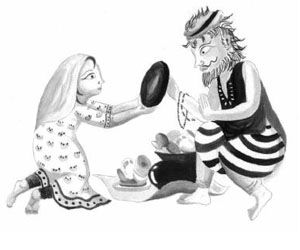
Long ago in a place called Seri, two salesmen sold pots, pans and handmade trinkets. They
decided to divide the town between them. They also agreed that it was alright for the other
to hawk his wares
after the first had gone through his designated area.

One day, one of them was coming down a street when a poor little girl saw him and asked
her grandmother to buy her a bracelet. “We are too poor. We can’t afford it,”
replied the
old grandmother. “Since we don’t have any money, we can exchange one with our black
sooty old plate,” suggested the little girl. The old woman agreed to give it a try, and so she
invited the dealer in.
Seeing that they were poor humble people who probably had no money, the salesman did
not want to waste his time with them. Though the old woman pleaded with him, he said
he had no bracelet that she could afford to buy. Then she asked: “We have an old plate
that is useless to us, can we barter it for a bracelet?” The man took the plate and examined
it. He accidentally scratched the bottom of the plate, and to his surprise, discovered gold
gleaming underneath the black soot. The black sooty old plate was actually a golden plate!
But he didn’t tell the old woman of his discovery. Instead, he decided to deceive her
so he
could get the plate for virtually nothing. “This is not worth even one bracelet. There is no
value in this. I don’t want it!” he lied, and left thinking he would return later when they
would accept something of a lesser value for the plate.
Meanwhile, the second salesman who had finished peddling in his appointed part of the
town, came to the area where the first had been earlier. He ended up at the same house.
Again, the poor little girl begged her grandmother to trade the old plate for a bracelet. Seeing
that the second merchant was a nice gentle-looking man, the old woman invited him in and
offered to trade the same black sooty old plate for one bracelet. When he examined it, he
also noticed that it was pure gold under the grime. “All that I own, my goods and all my
money, are not worth as much as this gold plate!” he exclaimed kindly to the old woman.
Of course, the woman was shocked when she heard this, but the merchant’s honesty also
proved that he was indeed a good and honest fellow to her. So she said she would be happy
to accept whatever he could trade for it. “I’ll give you all my pots, pans and trinkets, plus
all my money, if you will let me keep just eight coins and my balancing scale, with its cover

to put the gold plate in,” said the salesman. “Deal,” replied the old woman. The trade was
made and the second merchant went down to the river, where he used his remaining eight
coins to pay the boatman to ferry him across.
Meanwhile, the greedy salesman had returned to the old woman’s house, dreaming of huge
imaginary profits in his head. When he met the little girl and her grandmother again, he
told them he had changed his mind and was willing to offer a few cents, but not one of his
bracelets, for the useless black sooty old plate. “Sir, you lied to us,” replied the old woman
and then she calmly told him of the trade she had just struck with the honest salesman.
Instead of being ashamed, the greedy salesman was upset that he had lost the precious
plate that must be worth a hundred thousand. “Which way did he go?” asked the dishonest
merchant. She told him the direction, and he promptly dropped all his things right at her
doorstep and ran down to the river, thinking: “He robbed me! He robbed me! He won’t
make a fool out of me!”
At the riverbank, he saw the boatman ferrying the honest salesman halfway across the river.
“Come back, come back!” he shouted to the boatman. But the good merchant instructed
him to keep rowing, and so he continued crossing the river.
Seeing that there was nothing he could do, the greedy salesman exploded with rage. He beat
his chest, and jumped up and down. He was so angry and filled with so much hatred for
the honest man, who had gotten the golden plate, that he coughed out blood, had a heart
attack and died on the spot!
The moral is

honesty is the best policy.
irawan Religi